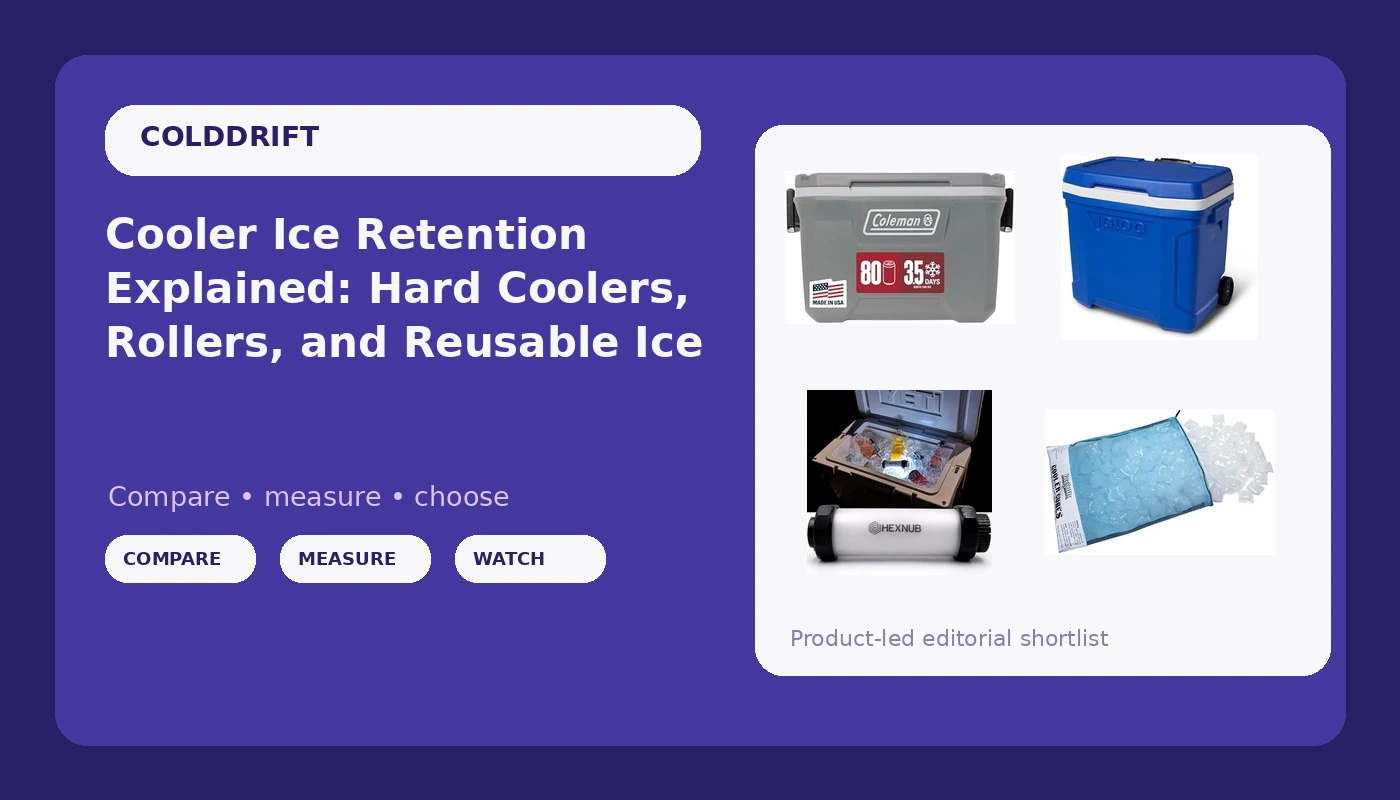
Two coolers leave the dock on Thursday with the same 20 pounds of ice. Sunday morning one still has cubes, the other has a puddle and a warm package of walleye. The difference is almost never the sticker on the lid. It is cooler ice retention, and it comes down to three things: how thick the insulation is, how well the gasket seals, and whether the box is honestly sized for what you put in it. This explainer covers what a "keeps ice up to X days" claim actually measures, where a cooler loses its cold, and how four pieces of gear (a hard-sided cooler, a wheeled ice chest, an interior light, and reusable ice) fit together on a real trip.
Related: How to Run a 3-Day Ice Test on Any Cooler →
Quick answer
Ice retention is how long a cooler holds ice under real use, and it is governed by wall thickness and insulation, lid gasket seal, latch pressure, and how often the lid comes open. For most trips the practical setup is a well-sealed hard cooler sized to the load, wheels if the loaded box has to travel, and reusable ice or an interior light as support rather than as a replacement for ice.
Four useful options
| Model | Best fit | What stands out |
|---|---|---|
| Coleman Classic Series Insulated Portable Cooler, Leak-Resistant Outdoor Hard Cooler Keeps Ice up to 5 Days, 52/70/120/150 Quart | Base camp, tailgate, or boat where the box stays put | Hard-sided leak-resistant build, manufacturer states ice retention up to 5 days, offered in 52, 70, 120, and 150 quart sizes |
| Igloo Hard Coolers | Profile II Series | Insulated Ice Chests | Roller Cooler with Wheels | Trips where the loaded cooler has to move | Insulated hard-sided ice chest in a roller format with wheels |
| HEXNUB Cooler Box Light Waterproof Rechargeable LED for YETI RTIC and ORCA | Digging through the box after dark | Waterproof rechargeable LED designed to fit YETI, RTIC, and ORCA cooler interiors |
| Cooler Cubes 5 lb Bag of Reusable Ice Cubes, Refreezable Ice Cubes for Coolers | Drink coolers and day trips with no meltwater | 5 lb bag of reusable, refreezable cubes sized for cooler use |
The everyday hard cooler: Coleman Classic Series Insulated Portable Cooler
This is the shape most people picture when they hear the word cooler: a hard-sided box with a lid, handles, and a drain. The size spread is the real story here. A 52 quart is a two-hand carry for one person when loaded, and a 150 quart is a two-person lift even when it is only half full. Buy the size your back can actually move, because a cooler that stays in the truck because nobody wants to lift it keeps nothing cold.
The trade-off is construction. This class of cooler is typically injection molded, which means thinner walls and a lid that insulates less than a rotomolded box. It will not match a premium rotomolded cooler on a 90 degree day, and the up to 5 day figure assumes favorable conditions: a closed lid, moderate ambient temperature, pre-chilled contents, and a good fill ratio. It will do the job for a weekend at the lake, a tailgate, or a boat where the box sits in the shade and gets opened a handful of times a day.
The wheeled hauler: Igloo Hard Coolers | Profile II Series | Insulated Ice Chests | Roller Cooler with Wheels
Wheels are a logistics feature, not a performance feature, and on a long walk from the parking lot to the water they matter more than a fraction of an inch of foam. If you have ever carried a full cooler 200 yards across a gravel lot, you already know which end of that trade you want.
The trade-off is bulk. Wheels and a handle assembly take up space that could otherwise be insulation or interior volume, and rollers are less comfortable on soft ground. On sand and steep rough rock the wheels dig in and you end up dragging the box anyway. Decide based on your actual path: pavement, boardwalk, dock, and packed gravel favor wheels. Deep sand does not.
The after-dark accessory: HEXNUB Cooler Box Light Waterproof Rechargeable LED for YETI RTIC and ORCA
Most cooler frustration after dark is not a cold problem, it is a visibility problem. You open the lid, hold a phone flashlight in your teeth, dig around, and leave the box open twice as long as you meant to. Every one of those extra seconds is cold air leaving the box and warm air taking its place.
The trade-off is scope. This is a cooler light, not a campsite lantern, and it is built around specific cooler interiors, so confirm that your box is one of the listed brands before buying. It does not change ice retention by itself. What it changes is how long your lid stays open, and over a three day trip that is not nothing.
The reusable ice option: Cooler Cubes 5 lb Bag of Reusable Ice Cubes, Refreezable Ice Cubes for Coolers
Reusable cubes are a different tool, not a smaller bag of ice. Because they do not melt, they leave no water in the bottom of the box, which keeps labels, bread, and anything paper from turning into pulp, and there is nothing to drain and replace mid-trip.
The trade-offs are honest ones. Reusable cubes need freezer space before the trip and time to refreeze after it, so they work best when you have a home freezer and a little planning. They also occupy room that bagged ice would fill, and they are not a stand-in for ice on a multi-day trip with raw food, where a full mass of ice is doing the heavy lifting. Use them for drinks, day trips, and the small cooler that rides in the cab.
Prices and availability may change. Product images, names, and retailer links are matched to specific listings, so confirm the exact model, size, and warranty on the current listing before you buy.
What a "keeps ice up to 5 days" claim actually measures
The number on a cooler label is a manufacturer's ice retention figure, and it is measured under conditions a real trip rarely reproduces. The usual assumptions are a cooler that starts cold, a lid that stays closed, a moderate ambient temperature, and a load that is mostly ice with very little empty air. Change any one of those and the number moves.
Three variables dominate. The first is insulation. Wall thickness and foam quality decide how fast outside heat gets in, and this is where rotomolded coolers separate themselves: they are built as a single piece with thick walls, which is why they hold ice longer, weigh more, and cost more. Injection molded coolers like the Coleman and Igloo class here are lighter and cheaper, with thinner walls and lids that insulate less. Neither construction is a lie. They are just built for different trips.
The second is the gasket, the rubber seal that runs around the lid. A gasket that seats cleanly and stays compressed blocks the exchange of cold air for warm. A warped, gritty, or dried-out gasket is a cooler that lies to you. The third is the fill ratio. A cooler two thirds full of ice and cold food has very little warm air to chill. A cooler holding four drinks and a lot of empty space is mostly an insulated box full of air, and air warms quickly.
Opening frequency is the wild card. Every time the lid comes up, the cold air that has settled low pours out and warm air replaces it. That is why the same cooler performs worse when it gets opened twenty times at a tailgate than when it gets opened four times on a boat, and why anything that shortens each dig, including an interior light, is a small but real factor.
Gaskets, latches, and drain plugs: the three failure points
The gasket is the whole game. Check it before every trip: run a finger around the channel, look for grit, cracks, or a section that no longer sits flat, and clean it with warm water. A lid that closes with a soft thud instead of a firm seal is telling you something.
Latches hold the gasket compressed. Rubber strap latches tend to survive rough roads better than plastic clips that pop open on washboard gravel, and a latch that has stretched will let the lid lift just enough to leak cold. If a latch is loose, the fix is a replacement part, not a bungee cord.
Drain plugs are a feature until they leak. Test yours at home with the cooler full of water, not on the boat ramp. A plug that drips will drain your ice over a weekend, and the water that should have stayed in the box ends up in your truck bed.
How to judge a cooler before you buy it
Work through these in order, because the early answers eliminate most of the field.
- Size the load first. Add up what actually goes in the box (drinks, food, ice) and buy the smallest cooler that holds it. A full 150 quart cooler loaded with ice is a two-person lift.
- Decide how the cooler moves. If it travels more than a few steps while loaded, wheels change the math more than any spec on the label.
- Inspect the seal and the latches. Check the gasket channel for a clean seat and confirm the latches clamp down firmly.
- Pre-chill the box the night before with a sacrificial bag of ice, then dump the meltwater before you load it.
- Pack it at least two thirds full, keep the lid shut, and log ice at 24, 48, and 72 hours on your first trip so you know what your box actually does.
Practical guidance for packing and hauling
- Chill everything before it goes in. Warm food and warm drinks spend your ice cooling themselves.
- Use block ice or large cubes for the base layer, and keep small cubes for drinks in a separate small cooler.
- Fill the empty space. A towel, a frozen water bottle, or a second bag of ice cuts down the air volume the cooler has to keep cold.
- Drain the water at the end of each day. It soaks anything sitting in the bottom and speeds up the melt on what is left.
- Keep the cooler out of direct sun and off hot surfaces. A box sitting on July asphalt is fighting a battle it cannot win.
- Write the load time on the lid. You will not remember when the ice went in, and the log is the only honest spec.
Which option should you choose?
Choose the Coleman Classic Series Insulated Portable Cooler when you want a hard-sided insulated box for base camp, a tailgate, or a boat where the cooler stays put and you want the widest choice of sizes. Choose the Igloo Hard Coolers | Profile II Series | Insulated Ice Chests | Roller Cooler with Wheels when the loaded cooler has to travel over pavement, boardwalk, or packed gravel and you would rather roll it than carry it. Choose the HEXNUB Cooler Box Light Waterproof Rechargeable LED for YETI RTIC and ORCA when you dig through the box after dark and want the lid open for less time. Choose the Cooler Cubes 5 lb Bag of Reusable Ice Cubes, Refreezable Ice Cubes for Coolers when you want cold drinks without a puddle in the bottom of the cooler.
The ice retention figures referenced here come from the manufacturers, not from a controlled test run for this article. Ambient temperature, sun exposure, fill ratio, and how often the lid opens will change what you see in your own cooler. Before buying, confirm the exact size, interior dimensions, and warranty on the current listing, and check the light against your specific cooler brand.
The bottom line
Buy the cooler for the trip you actually take, not the trip on the label. If the box sits in the shade on a dock and gets opened a handful of times a weekend, a well-sealed hard cooler sized to your load is enough, and the money you save buys ice. If the loaded box has to move, wheels are worth more than a fraction of an inch of foam. If the lid is open every ten minutes, a light inside the box and reusable ice in the drink cooler will do more for your ice than any claim printed on a lid. And whatever you buy, run your own three day test once. A cooler is a promise, and you should know whether yours keeps it.