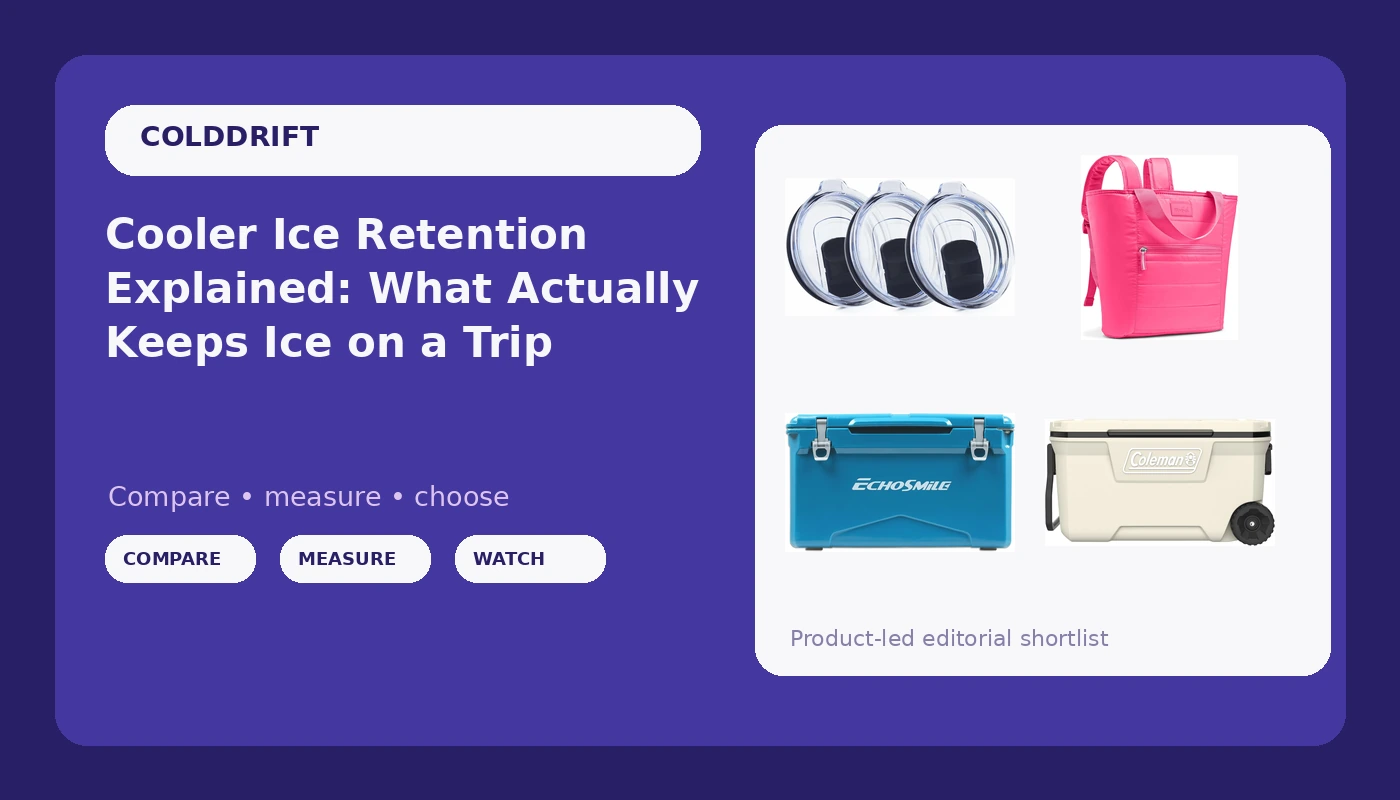
Cooler ice retention is the only spec that decides whether a trip ends well. Everything else, the handle, the hinge, the cup holder somebody molded into the lid, is decoration until the ice is still ice on day three. The problem most people run into is that cooler shopping is organized by price and by brand loyalty instead of by the three things that actually control ice life: how thick and how continuous the insulation is, how well the lid gasket seals, and whether the cooler is sized honestly for how you will use it. Buy a box too big and you cannot lift it when it is full. Buy one too small and you are restocking ice at a gas station on Saturday morning. This explainer walks through the four options in this group and the reasoning that connects them.
Related: How to Run a Three-Day Ice Test at Home →
Quick answer
Ice retention is governed by insulation thickness and continuity, gasket seal quality, and how often the lid opens. Rotomolded hard coolers generally hold ice longer than soft-sided coolers because they have thicker, seamless walls, but they are heavier and more expensive. Soft-sided insulated totes are lighter and easier to carry for a day trip, and they give up ice life in exchange. Wheeled hard coolers sit in the middle: they carry like a rolling suitcase and insulate like a hard box. Replacement drinkware lids are a separate category entirely, but they follow the same gasket logic as a cooler lid.
Four useful options
| Model | Best fit | What stands out |
|---|---|---|
| EchoSmile 25/30/35/40/60/75 Quart Rotomolded Cooler | Multi-day trips where ice life matters most | Rotomolded single-piece construction and a wide range of sizes |
| Coleman Classic Series Insulated Portable Rolling Cooler with Wheels | Long walks from the truck to the water | Integrated wheels, leak-resistant hard body, manufacturer-stated ice retention up to 5 days |
| Fit & Fresh Mari Insulated Soft Backpack Cooler Tote | Day trips, lunches, short hauls | Backpack straps, insulated soft body, 12-can capacity |
| 3 Pack 20 oz Tumbler Lid, Magnetic Slider Replacement Lids | Restoring drinkware that no longer seals | Magnetic slider, spill-resistant design, BPA free, three lids per pack |
The rotomolded hard cooler: EchoSmile 25/30/35/40/60/75 Quart Rotomolded Cooler
The trade-off with rotomolding is mass. Thicker walls and a heavier shell mean better insulation and a cooler you will not want to carry alone when it is loaded. A 60 or 75 quart rotomolded box full of ice, drinks, and a limit of walleye is a two-person lift, and that is before you add the walk from the parking lot. The 25 to 35 quart sizes are the ones most people can actually manage solo. If your trips are single days with an early start, the extra ice life may not be worth the weight. If you are leaving Thursday and coming back Sunday, it usually is.
The wheeled hard cooler: Coleman Classic Series Insulated Portable Rolling Cooler with Wheels
Treat the manufacturer's ice-retention figure as a claim made under favorable conditions, not a promise about your trip. Published ice-life numbers generally assume a pre-chilled cooler, a full load, a cold start, and a lid that stays shut. Open the lid every twenty minutes for another soda on a 90-degree afternoon and the math changes quickly. That does not make the claim dishonest, it makes it conditional. The way to use a number like that is as a relative signal about insulation class, not as a schedule you can plan a weekend around.
The soft-sided tote: Fit & Fresh Mari Insulated Soft Backpack Cooler Tote
Soft coolers trade ice retention for weight and packability, and the weak point is the closure. A zipper, not a gasket-and-latch system, is what stands between your food and the outside air, and zippers leak air more readily than a compressed rubber gasket does. That is fine for a four-hour window. It is not fine for a three-day trip where the cooler sits in a boat under direct sun. The 12-can capacity tells you the intended mission: a day's worth of drinks and a sandwich, not a weekend of provisions.
The replacement lid set: 3 Pack 20 oz Tumbler Lid, Magnetic Slider Replacement Lids
Compatibility is the thing to verify before ordering. The listing names specific cup and mug sizes, and it explicitly says old style RTIC rather than current production, which tells you the fit is generation-specific. Measure your cup opening and check the stated sizes against what you own. These lids fit drinkware, not cooler bodies, so do not expect them to solve a hard cooler with a tired gasket. That is a separate part, and often a separate cooler.
Prices and availability may change. Product images, names, and retailer links must be matched by verified ASIN. Do not state a current price, rating, stock status, or measured result without current evidence.
How ice retention actually works
Ice does not disappear because a cooler is unlucky. It disappears because heat gets in, and heat gets in through four routes.
The first is conduction through the walls. Insulation works by trapping air or gas in a foam structure that slows heat transfer. Thicker foam slows it more. This is the main reason a rotomolded box with two to three inches of polyurethane outperforms a thin-walled picnic cooler, and it is why cheap coolers often use thinner, less dense foam that loses its advantage the moment the outside temperature climbs.
The second is the gasket and lid fit. A lid that does not compress its rubber seal against the rim lets cold air escape and warm air enter through the gap, and it also lets meltwater vapor out, which accelerates ice loss. A gasket that has stiffened, cracked, or warped is the most common single failure point on an otherwise sound cooler. This is why the drain plug matters too: a plug that weeps is a slow, continuous loss of the cold reservoir you paid for.
The third is surface area relative to volume. A large cooler with a small amount of ice has proportionally more wall area for heat to cross. A full cooler holds ice dramatically longer than a half-full one, which is why the classic advice is to fill empty space with more ice, or with pre-chilled items, rather than with air.
The fourth is how you use it. Every lid opening exchanges the cold air sitting above the ice for warm ambient air. Sun exposure on a dark lid raises the surface temperature and increases the gradient driving heat inward. Putting a cooler in the bed of a truck in direct July sun and opening it every half hour will defeat insulation that would otherwise hold for days.
Rotomolded versus injection-molded construction
Rotational molding, usually shortened to rotomolded, means the shell is formed as one continuous piece by rotating a mold filled with plastic powder while it heats and fuses. The result is a seamless body with thicker, uniform walls and no panel joints. That is why rotomolded coolers are heavier and more expensive, and it is also why they resist flexing, cracking, and the kind of impact that splits a cheaper box dropped off a tailgate.
Injection molding is faster and cheaper. Plastic is injected into a mold, and the resulting shell is thinner and often assembled from multiple parts with seams and a separate liner. Injection-molded coolers are lighter and easier to carry, and they typically have a shorter practical ice life because there is simply less insulation material between the ice and the outside world.
Neither process is a moral virtue. The question is whether the trips you take justify the weight and the price. A person who camps twice a year and tailgates four times does not need a rotomolded box. A person who leaves Thursday and returns Sunday, or who keeps a client's catch cold through a 90-degree afternoon, is buying insulation as insurance.
A practical order of decisions:
- Decide how many days of ice you actually need, and add half a day of margin for weather.
- Size the cooler to the contents plus ice, then confirm you can lift or roll that weight when it is full.
- Decide whether the cooler gets carried, rolled, or worn, because that determines the form factor more than anything else.
- Inspect the gasket and latches before committing, since the seal is where most ice life is lost.
- Match the cooler to the trip you take most often, not the trip you take once.
Habits that protect your ice
- Pre-chill the cooler with a bag of ice or cold drinks the night before, then dump the meltwater before loading.
- Start with block ice or a large frozen jug at the bottom, and cubed ice above it to fill the gaps.
- Fill dead space with pre-chilled food, frozen water bottles, or a towel, because air is the enemy of ice life.
- Keep the cooler out of direct sun and off hot pavement or a hot boat deck.
- Group openings: get everything you need in one lid lift rather than six.
- Check the drain plug before every trip, not during one, and confirm the gasket still sits flat and soft against the rim.
- Carry a small soft tote for the drinks you will actually reach for, so the big cooler stays shut.
Which option should you choose?
Choose the EchoSmile 25/30/35/40/60/75 Quart Rotomolded Cooler when ice life across multiple days is the priority and you can accept the weight and the price. Choose the Coleman Classic Series Insulated Portable Rolling Cooler with Wheels when the cooler has to travel a distance from the vehicle and you want hard-sided insulation without carrying it. Choose the Fit & Fresh Mari Insulated Soft Backpack Cooler Tote when the trip is measured in hours rather than days and hands-free carrying matters more than maximum ice retention. Choose the 3 Pack 20 oz Tumbler Lid, Magnetic Slider Replacement Lids when the drinkware you already own has lost its seal and you want to replace the lids rather than the cups.
One caveat on all of this: published ice-retention figures come from manufacturers and from tests run under specific conditions, and this article does not report independent measured results. Treat every "keeps ice up to" number as a manufacturer claim and a relative indicator of insulation class, not as a guaranteed schedule. The same goes for spill-resistance and compatibility claims on drinkware lids, which depend on the exact cup generation you own.
The bottom line
Ice retention is a construction question before it is a brand question. Rotomolded walls and a well-seated gasket are what buy you days instead of hours, and a wheeled hard cooler is the compromise that makes that insulation practical to move. Soft-sided totes are for short windows and easy carrying, and they are honest about it. Whatever you buy, verify the gasket, test the drain plug, pre-chill the box, and size it so you can still lift it when it is full. A cooler is a promise about cold, and the only way to know whether yours keeps it is to look at what is left on the last morning.