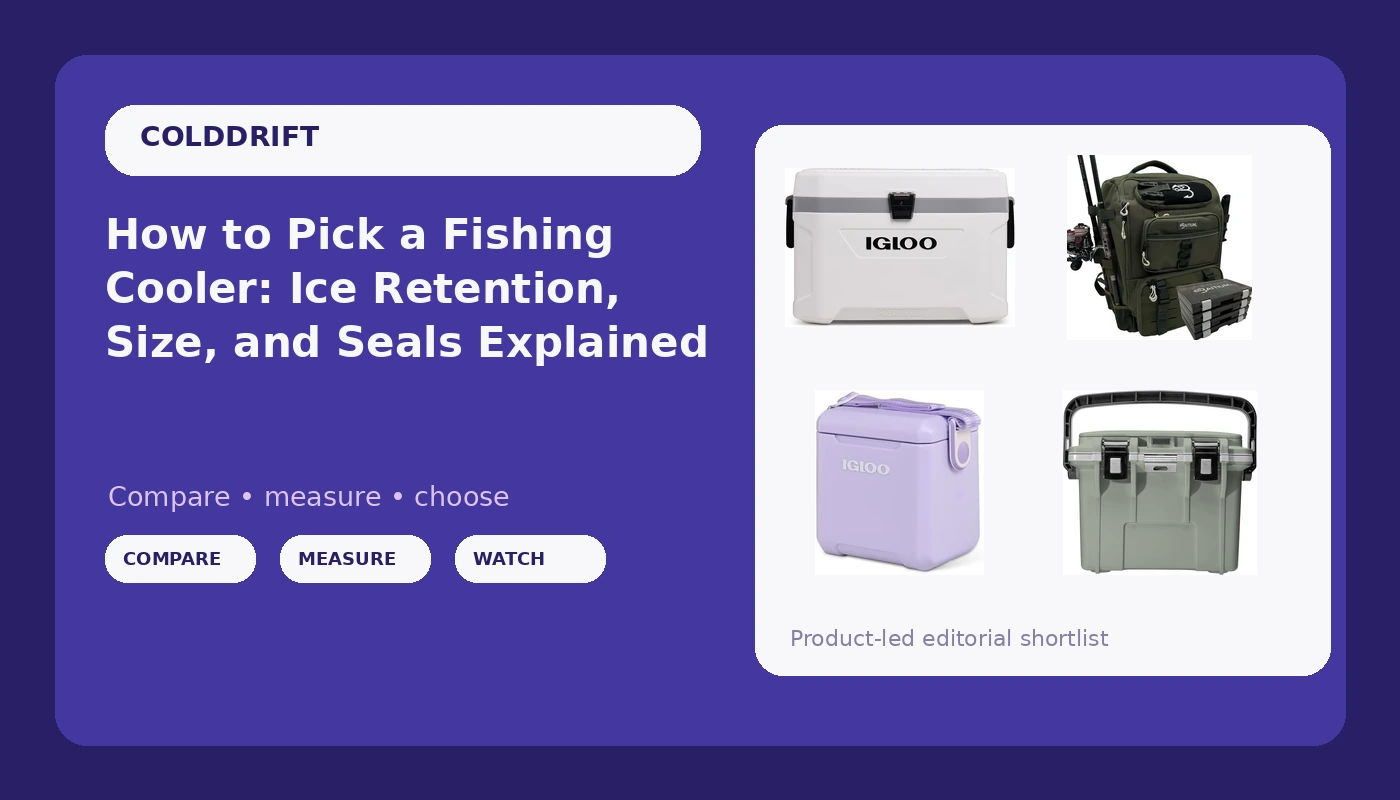
Fishing cooler ice retention is the only number that matters once you leave the dock, and it is also the number most product pages refuse to give you straight. A cooler that keeps ice through a long, hot day protects your catch, your bait, and your lunch equally. A cooler that quits early turns a good trip into a smell you will remember for a month.
The problem is that "cooler" now covers at least four different objects. There is the rigid chest that rides on a boat deck. There is the rolling picnic box that lives in a garage and comes out for tailgates. There is the compact hard cooler for small loads and long days. And there is the fishing backpack with an insulated pocket that you carry on your back when the walk-in spot has no boat ramp. Buying the wrong one is not a quality problem, it is a category problem.
Related: How Ice Retention Actually Works, and Why the Gasket Decides It →
Quick answer
Match the cooler to the trip rather than to the biggest number printed on the lid. A hard shell chest for boat decks and fishing days, a rolling hard shell for picnics and tailgates, a compact hard cooler for small loads that need to stay cold for hours, and a cooler-equipped fishing backpack when you are carrying tackle on your back instead of in a truck bed. Ice retention depends on insulation, the lid seal, and how often you open the thing, not on marketing copy.
Four useful options
| Model | Best fit | What stands out |
|---|---|---|
| Igloo Marine Cooler | Boat decks and fishing trips | Insulated hard shell ice chest positioned for fishing, camping, and boating |
| Baitium Fishing Backpack | Shore, wade, and hike-in fishing | 40L pack with rod holders, an insulated pocket, a rain cover, and four tackle trays |
| Igloo Tag Along Too Coolers | Picnics and tailgates | Insulated hard shell picnic style cooler that rolls |
| Pelican 14 Quart Cooler | Small loads and long single days | Compact 14 quart hard cooler |
The deck-ready chest: Igloo Marine Cooler
The trade-off with any rigid chest is weight and portability. There are no wheels here, so a full cooler gets carried by hand, and the person carrying it is usually also carrying rods. That is fine when the truck backs up to the boat ramp and a problem when the access is a quarter mile of sand. The compensation is a stiff wall and a lid that closes against a full perimeter, which is the geometry that keeps cold air where you put it.
The carry-everything option: Baitium Fishing Backpack
Be honest about what an insulated pocket is. It is a cold compartment inside a soft pack, which means thinner insulation than a hard chest and more exposure to body heat and sun. It is the right tool for a shore lunch, a few drinks, and bait that needs to stay cool for a morning. It is not the tool for keeping a limit of walleye cold through a three-day trip. Buy it for the walk-in spots and keep a hard chest in the truck.
The rolling picnic cooler: Igloo Tag Along Too Coolers
Rolling coolers make one trade you should understand before buying. Wheels and a handle add convenience and take up space that could otherwise be insulation or interior volume, and wheel wells are a place where a hard cooler can collect grit. On pavement and packed gravel this is a non-issue. Dragged across a rocky boat ramp or a soft beach, a rolling box is working against itself. If your trips start and end on a parking surface, this is the least annoying way to move a heavy load.
The compact hard cooler: Pelican 14 Quart Cooler
Capacity is the honest constraint here. Fourteen quarts is a small cooler, and the single biggest cause of disappointing ice life is a cooler packed too full of warm food and drinks with too little ice to absorb the heat. A small box used correctly, meaning pre-chilled contents and a full ice load, will outperform a big box used badly. But if you need to feed four people for two days, no technique fixes the volume.
Prices and availability may change. Product images, names, and retailer links must be matched by verified ASIN. Do not state a current price, rating, stock status, or measured result without current evidence.
What ice retention actually measures
Ice retention is a duration: how long ice remains ice inside a closed cooler under real conditions. It is not a fixed property of a model, which is why two people with the same cooler can report wildly different results. The variables that move the number most are ambient temperature, direct sun, how much ice you started with, how cold the food and drinks were when they went in, and how many times the lid came open.
The cooler itself contributes three things. Insulation thickness and foam quality slow heat transfer through the walls and lid. The lid seal, usually a rubber gasket, closes the gap where cold air escapes and warm air enters. The latch system holds that lid down under tension so the gasket stays compressed. A cooler with excellent foam and a gasket that no longer seats will underperform a cheaper cooler with a clean seal.
There is a fourth factor that gets ignored until it ruins a trip: the drain plug. A plug that does not seal is an open hole in the coldest, heaviest part of the box. Water from melted ice drains away, which is convenient, and warm air enters through the same channel, which is not. Check the plug seals before you load the cooler, not after the ice starts disappearing.
Finally, ice-to-contents ratio. A cooler that is two-thirds ice by volume behaves very differently from one packed with room-temperature drinks and a single bag of ice on top. The ice is not just the cold source, it is the thermal mass that absorbs heat coming in through the walls. Skimp on it and you have built a very expensive lunch bag.
Sizing, sealing, and the details that fail first
- Measure the space before you buy. Boat lockers, truck beds, and trunk openings are all smaller than they look, and a cooler that does not fit gets left behind.
- Decide who lifts it. A full hard cooler is heavy. If you cannot lift it loaded, either size down or buy something with wheels.
- Inspect the gasket in person if you can. Run a finger around the lid seal and look for pinches, gaps, or a seal that has gone hard. This is the part that decides whether the cooler keeps its promise.
- Test the latches and the drain plug before the first trip. Fill it, close it, tip it, and watch for drips. Ten minutes at home beats a wet truck bed.
- Pre-chill. Cold contents and cold walls extend ice life far more than any accessory.
Practical guidance for a real trip
- Freeze what you can. Frozen water bottles double as ice and as drinking water later, and they do not leave a puddle.
- Keep the cooler out of direct sun. A blanket or a shaded spot under a seat is worth more than an extra inch of foam.
- Group your openings. Every lid lift dumps cold air. Decide what you need, then open once.
- Use a separate small bag or box for drinks if you have one. Drink traffic is what kills the main cooler's ice.
- Bring a backup plan for the drain plug. A spare plug costs almost nothing and is the cheapest insurance in cooler ownership.
- Label nothing as bear resistant and store food accordingly unless the manufacturer states it for your specific model.
Which option should you choose?
Choose the Igloo Marine Cooler when the cooler rides on a boat deck or sits in a truck bed for fishing and camping trips and you want a rigid insulated chest. Choose the Baitium Fishing Backpack when you are walking in, wading, or hiking to fish and need rods, tackle, and a small cold compartment on your back. Choose the Igloo Tag Along Too Coolers when the trip is a picnic, a tailgate, or a family outing and you want to roll a hard shell cooler instead of carrying it. Choose the Pelican 14 Quart Cooler when your load is small, your day is long, and being able to lift the cooler fully loaded matters more than interior volume.
One caveat applies to all four. Published ice-retention figures come from controlled tests with specific ice loads and specific ambient temperatures, and they rarely match your trip. Treat any claim as a starting point, verify the seal and the plug yourself, and judge the cooler on how it performs in your own conditions. Nothing in this article is a substitute for your own test.
The bottom line
Coolers are not one product category with a quality ladder. They are four different tools for four different jobs, and the failures people complain about usually trace back to picking the wrong category rather than the wrong brand. A rigid chest for the boat, a rolling box for the parking lot, a compact hard cooler for small loads, and a fishing backpack for the walk-in spots. Get the seal, the latches, and the drain plug right, load it with more ice than feels reasonable, and keep the lid closed. That is most of what separates a cooler that works from a cooler that lies to you.